Thursday, February 27, 2014

Rotorua to Taupo

Two days ago (Tuesday the 25th of Feb), K and I worked our way from Rotorua to Taupo.  These are two cities that sit in the heart of the north island of New Zealand as well as being in the heart of the thermal and recreational region of the north island.  This was a fantastically beautiful and diverse part of the country.  Anyone going to NZ should include this area on their trip.

Green and Blue Lakes near Rotorua

We were advised by our hotel to stop and see the Blue and Green Lakes before heading out of the Rotorua area.  They were a short 15 minute trip to the southeast of Rotorua to visit the Blue and Green Lakes.  Around them sits some incredible forests (including Redwoods brought in from California) and volcanic hill scenery.  The names of the lakes stem from the materials that sit in and on the bottom of the lakes and how well they reflect the sky.  A small isthmus sits between them that makes for some great photos of both.  Below are some pictures of these two lakes.  Absolutely stunning scenery - I hope the pictures do them justice.
Blue Lake 

 Green Lake (A Maori sacred sight and not as accessible as Blue Lake)
 
On the way out of Rotorua, we passed this sign.  I know Mom, Dad, Aunt Joan, and Uncle Sean would appreciate this sign.  Perhaps we need a few of these down in Florida?  Its a real nice way to say - "Look out for the old people."
 

Wai-o-tapu

After visiting the lakes around Rotorua, we started our 2 hour journey south to Taupo.  There are several geothermal parks between Rotorua and Taupo (this area sits on a couple of volcanic caldera).  You could spend a lot of time in this area and it would be incredible scenery and natural wonders.  We decided to visit Wai-o-tapu Geothermal Wonderland park.  Wai-o-tapu is Maori for "scared waters."  We picked it for the diversity and colors that this area offered over some of the other geothermal areas.  This particular area was formed in an eruption over 26,000 years ago.  The eruption was several hundred times more powerful than the Mount St. Helens eruption.  K and I spent a couple of hours in this park.  The day was beautiful (adding to what we saw on the land), but the scenery was one of beauty combined with the sheer awesome power of the earth.  I took over 100 pictures that day.  The pictures below only show a small part of the beauty (and violent nature of volcanic activity) we encountered in the park.  Of course, you also had to put up with the sulfur smell that goes along with geothermal activity (see our last picture!).  I know its quite a few pictures, but this is really only a sampling.
That's 100 degree plus water - that's on the Celsius scale folks! 
 The pools of water take on a different color depending on the temperature of the water and types of minerals in the water.  This one was a light green/blue and I think the picture captured it pretty close.
 Bubbling mud
 Bubbling water in what was called the "Champaign Pool"!
 The Champaign Pool is named for its bubbles.  It also combines many colors in one pool.
 The Champaign Pool from other views.
 Devil's Home not only looked like it, but sounded like it too.
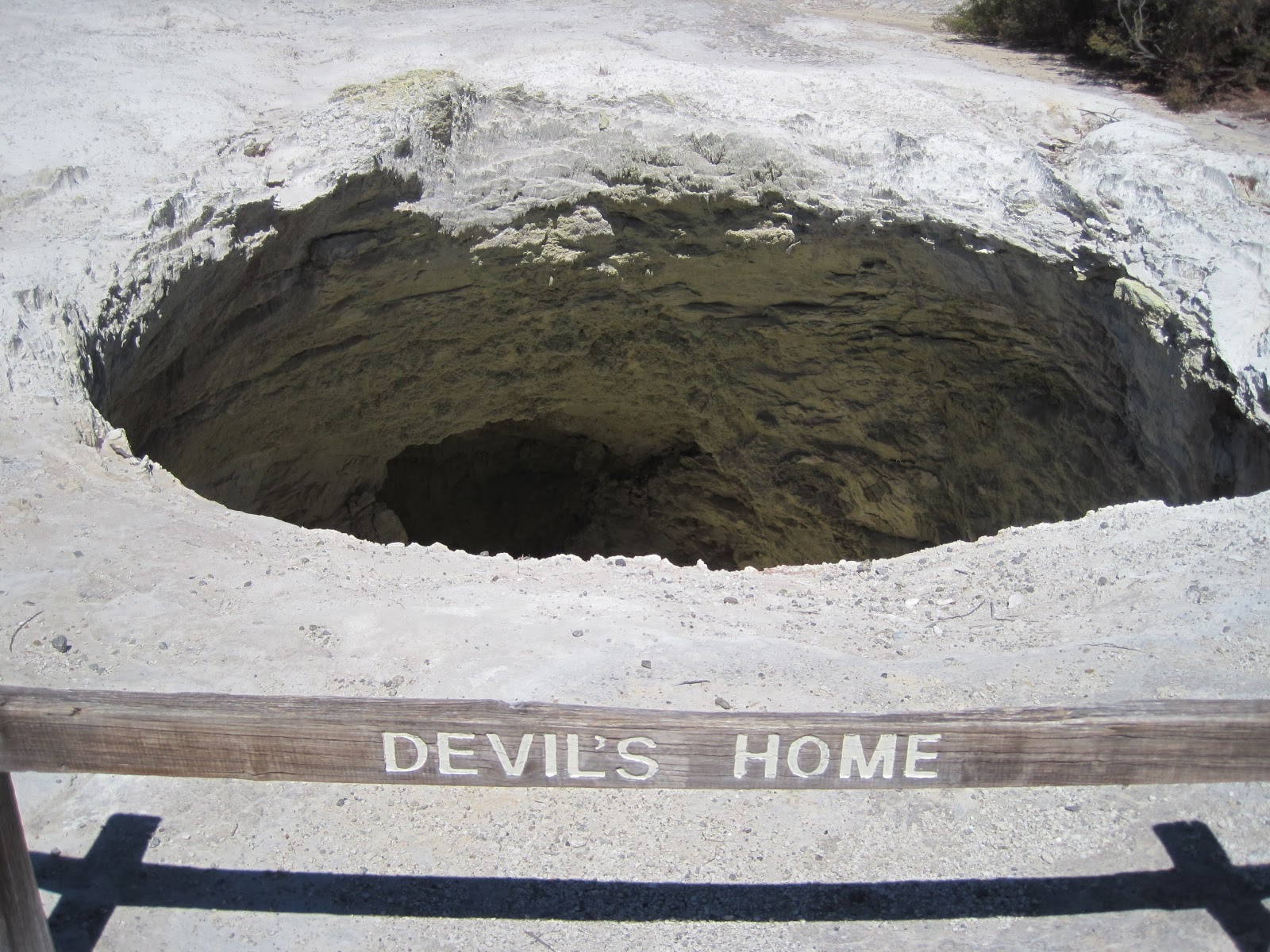
 Not the moon or a black and white photo - but it looks like it doesn't it?
 Boiling mud
 A river of mud that isn't moving.  I thought this was cool and eerie looking at the same time.
"Opal Pool" - for its color of course
 
 The orange shelf sits inside of the Champaign Pool.
 Sulphur cave - note the yellow on the walls
 Volcanic cliffs - felt like the material in the charcoal grill after burning all night.
 Yellow Pool.  That's water and not lemonade.
The beauty was accompanied by a smell like rotten eggs.  You had to suffer through it to see the park.  On a positive note, your sinuses were clear at the end of the day.

Huka Falls

From Wai-o-tapu we continued our journey to Taupo.  We saw this thermo energy plant on the way.  No - that's not a nuclear plant - it's thermal energy.  Not too many places that have one of these.


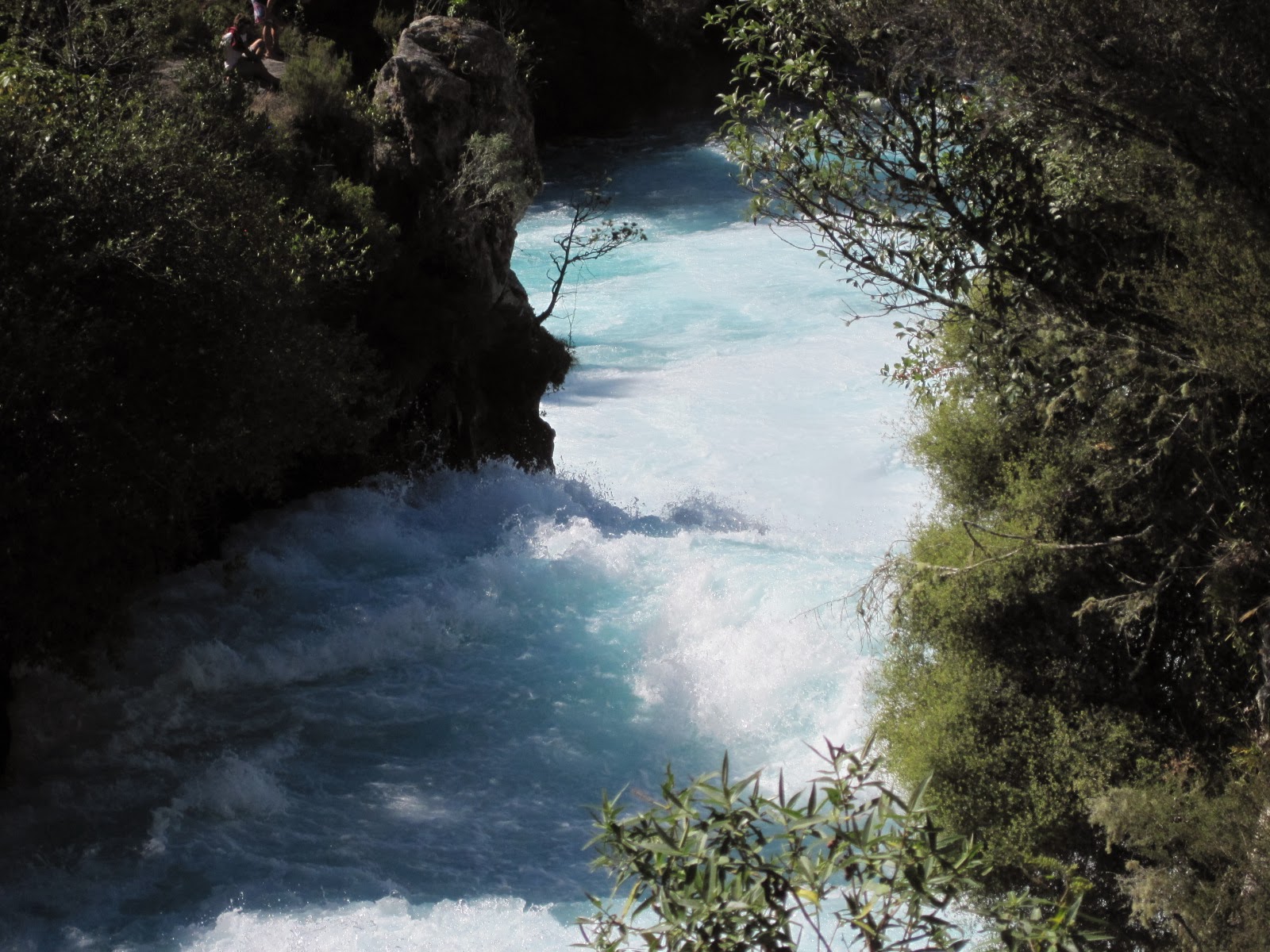
On the way to Taupo is also one of the most famous falls in New Zealand - Huka Falls.  Huka means foam in Maori.  The falls is at the start of the Waikato River (which empties from Lake Taupo), which is New Zealand's longest river.  The river narrows from approximately 100 meters across into a narrow canyon only 15 meters across.  About 60,000 gallons of water shoot through this small space per second!  Supposedly, it is NZ's most visited natural attraction.  As you can see below, this is an incredible force, but a beautiful one as well.  To give you some understanding of the scale of this falls, in the last picture is a rather large motor boat that took people into the foam at the bottom of the falls (kind of like the Maid of the Mist at Niagara Falls).  You'll have to open the picture to full size to see the boat.


Taupo

Our journey that brought us so much beauty on Tuesday was ultimately to get us to Taupo.  Taupo sits along the Waikato river at the top of Lake Taupo.  This is a huge crater lake right smack in the middle of the North Island of New Zealand.  It is New Zealand's largest lake.  It covers 238 square miles, and for comparison sake, Lake Tahoe covers 191 square miles and Lake Okeechobee in Florida covers 730 square miles.

Taupo is a cute town (about 23K population) that hosts many outdoor activities (hunting, fishing, climbing, boating, etc.).  It hosts a huge ironman competition that is expected to go off next week.  It is also situated right next to the Tongariro National Park where the Tongariro Alpine Crossing is found.  This is one of New Zealand's twelve "Great Walks."  Every New Zealander (and tourist) is encouraged to get a sense of the beauty of the country through these fantastic hiking routes.  Tongariro Alpine Crossing is the most popular of the Great Walks because it can be accomplished in the day - and some say it may be the most stunning.  K and I accomplished this 12 mile hike up and down "Mt. Doom" as it is called yesterday.  This is us, at the end of our day on Tuesday on a hill above Taupo.  In the other picture, Taupo is in the forefront of the picture, with Lake Taupo behind the city and way off in the distance is the Tongariro Maountin.  Yep - we hiked that sucker (bottom to top and down again).  More on that trek with my next post.

 
We were told by a driver in Auckland that if you don't like the scenery in New Zealand's north island, give it twenty minutes.  The trip from Rotorua to Taupo is about 1.5-2 hours.  So I would say that comment is pretty much right.  The beauty and diversity was stunning.  What's more, the same driver said the same applies to the south island of New Zealand, but the time there is only ten minutes between changes.  We can't wait to see it!

Tuesday, February 25, 2014

More on Rotorua

OK - only a week in and I am already getting a little behind (my boss Tom is probably chuckling - blogging for work or pleasure takes a lot of  time Tom!).  I am going to try to complete my report on Rotorua that covered both yesterday and part of today.  We had a fantastic day today and Rotorua was only a small portion so it seems a good part to fit in with my wrap up on Rotorua.

Rotorua

In my last post, I indicated that Rotorua is a little touristy.  I think that is an honest statement, but to be fair there are also some wonderful sights to be had in Rotorua too.  Don't skip it.

Yesterday, after our trip into Rotorua and taking the gondola ride to the hill overlooking Rotorua, we also managed to get downtown before heading to our Maori cultural experience.  It is a cute little town - and yes it is all about tourists, but still worth the visit.  Plenty of cafes, eateries, pubs, restaurants to at least make it worth a stop.  At our hotel's recommendation, we stopped in at the Pig and Whistle for a drink and bite to eat before getting ready for dinner.  Cute little place with good local beer selections where we also had a chance to talk to another U.S. couple that had just finished their trip to Australia.
By the way, our little blog posts seemed to have attracted some attention.  Over 300 reads in the last few days.  Some from as far as Korea.  So Kelly suggested that I put some information in about the hotels we chose (and why) and some of the restaurants we have eaten at.  So for those interested, we will try to do that at some point in the future.  However, it might have to wait until after we get home and have more time.

Here are a few pictures from the town.


From yesterday's posts, you can see Rotorua sits on a beautiful lake, so even if you just have a meal downtown and visit the lake, it is a beautiful setting and shouldn't be missed.

This morning, we got up and also visited the Government Garden in front of the Rotorua Museum.  The museum is suppose to be a "don't miss" center focused on the Maori and geology/geothermal activity in the area.  However, because we had already visited the War Museum and were visiting some of the best thermal areas New Zealand had to offer today, we decided to bypass the museum ("museum'ed out" was K's term).  Here are some pictures from the Government Gardens (created for the future British King/Queen visit at the turn of the 20th century).  The museum building (in Tudor style) is also pictured as it was in this area.  This is a lovely area of Rotorua and it is not touristy.


Lawn Bowling - the champion sport of the retired in NZ

This next part is for my brother-in-law Jimmy.  Jimmy, you would love to see that the game of bocce ball (called lawn bowling here) is alive and well.  On the Government Gardens, we found a large group of older men enjoying their morning lawn bowling.  Look at this folks - it was as busy and as full of life as any golf clubhouse in America!


K and I are trying to figure out how to bring this to America.  They would love it in places like Florida and Arizona.
 
There was also a hot spring (named Rachael Springs) right in the park as well - pictured below.  Little did we know this was just a vanilla, garden-variety, boring and small example of thermal activity we would see later today (more on that in my next post as I tell you about the Wai-o-tapu).  At the time, we were excited to see it. 


Maori Village Visit

If you come to the Rotorua area, you must attend one of the Maori cultural events.  This will include (typically) a welcoming ceremony, some small demonstrations on parts of their culture (tattooing, wood carving, dance, food preparation, etc.), a show (local dance/song), and a dinner (which should be from an earthen oven similar to a Hawaiian luau).  There are quite a few to choose from in New Zealand and even a few to choose from in Rotorua.  I did my research and picked the one that had the highest rating and the most positive comments.  Obviously, I am not equipped to compare since I only saw one, but I will tell anyone that wants to attend one, try the one put on by the Tamaki Maori Village.  You will not be disappointed.  We learned so much, met some great people, laughed a ton and just thoroughly enjoyed ourselves.  Below are some of the pictures from our visit.
Posing with the villagers

Food preparation - from the earthen oven

The show - Maori dance/song

Teaching men the haka

The village welcoming ceremony

The village welcoming ceremony

the village entrance

They pick you up at your hotel in a bus (they call a canoe for the purposes of your experience), learn a few Maori words on the way (ka pai - meaning no worries, good, or everything is ok and kia ora - which is a general purpose word for hello, goodbye, thank you, etc.), get some education about the Maori culture, see them dance and then have dinner.  The dinner was actually pretty good.  Usually on these type of things (just like a luau) you don't expect the dinner to be a highlight, but it was very tasty (especially the desert of Pavlov - a Aussie and Kiwi favorite).

Here is a small part of a video of one of the dances in the show - the famous haka or war dance of the Maori.

Some of the educational parts of the visit were very very interesting.  First off, for everyone coming, learn there are several variations on how some Maori words - including most importantly their ancestral name - are pronounced.  Most of the Maori we heard pronounced their people as  "ma dee" with a kind of rolled "r" and "d" together at the "dee".  If you see Maori people, you will often see them tattooed - still a strong part of their culture.  Face tattoos carried a lot of meaning.  For men, the tattoos from eye to chin were about genealogy.  One half the face (not sure if it was right or left) identified mother blood lines while the other side the father's bloodlines.  [Man - that would have made my research on Ancestry.com a lot easier if we all had that.]  Above the eye was space for tattoos identifying rank and role - for example master woodworker.  Women usually just had tattoos around the lips and chin.  These were a sign of giving birth to a child.  [How about a tattoo with the scars of first child birth today ladies?]

The Maori culture - as with all cultures - have some interesting and wonderful aspects.  There are also some idiosyncrasies and warts that all would like to ignore or hide.  If you have a chance to come to NZ, learn about them and you'll be better for the experience.

Blue Lake, Green Lake and Wai-o-tapu Thermal Wonderland to come

So much more to report on our trip today.  The most amazing and beautiful part of our trip so far.  I have to show you some of the most amazing scenery I have seen in my life (I only hope the pictures do it 1/2 the justice).  However, we are packing up for our 12 mile trek across the Tangariro Crossing tomorrow (6am rise), so that is all for now.  I'll leave you with one picture from today's journey to wet your appetite and bring you back tomorrow.